
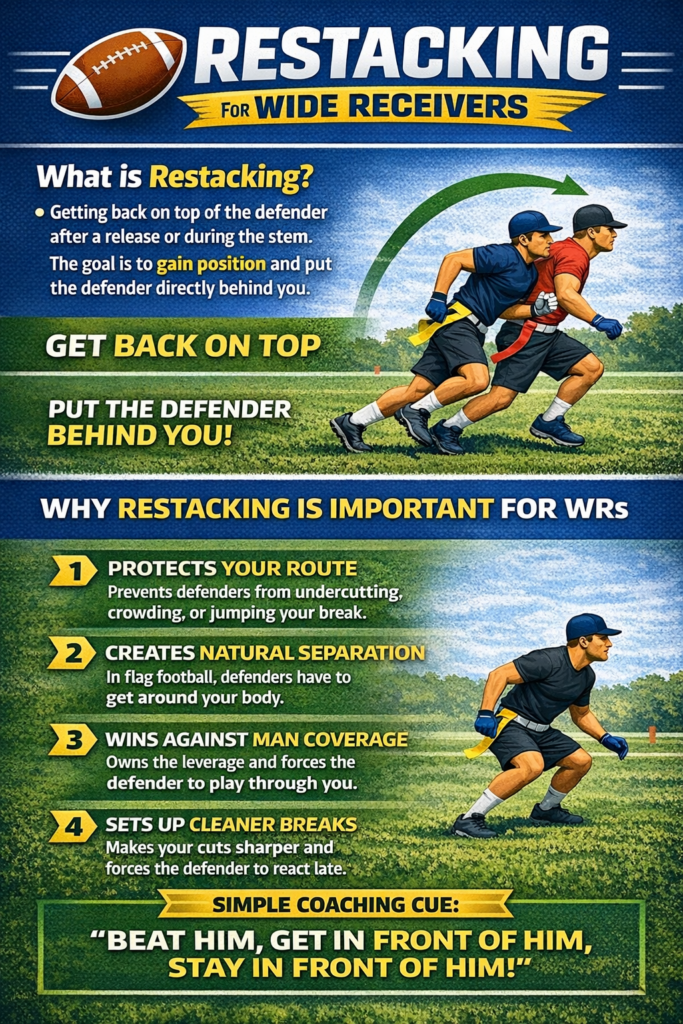
One of the most important route-running skills for wide receivers in flag football is learning how to restack a defender. Restacking means getting back on top of the defender after your release or during the stem of the route. The goal is to gain position and put the defender directly behind you. Below is why restacking for wide receivers is important!
When a receiver can win leverage early and then restack, they take control of the route and make life much harder on the defender. It’s a simple concept, but it can make a huge difference in how consistently receivers create space and win against man coverage.
Restacking for Wide Receivers: Why It Matters in Flag Football
What Is Restacking?
Restacking happens after the receiver gains an advantage on the defender. Instead of staying side-by-side or drifting into a poor angle, the receiver works back into position so they are directly in front of the defender. In other words, you want to get back on top and put the defender behind you. This allows the receiver to own the leverage, protect the throwing lane, and stay in control of the route. A simple coaching cue is: beat him, get in front of him, stay in front of him.
1. Restacking Protects Your Route
One of the biggest benefits of restacking is that it protects your route. When you get back on top of the defender, it becomes much harder for them to undercut the route, crowd your space, or jump your break. If the defender stays on your hip or works back in front, they have a chance to disrupt the route and make the quarterback hesitate. But when you restack properly, you create a clean path and keep the defender in a trailing position.
See Also: Flag Football Coaching Tips- Offense
2. It Creates Natural Separation
Restacking also creates natural separation. In flag football, defenders have to work around your body once you get back in front of them. That alone gives the receiver an advantage. Instead of needing a huge burst of speed or a perfect move every time, the receiver uses body position and leverage to stay open. Natural separation is often more reliable than trying to win purely with quickness, especially in tight man coverage situations.
3. It Helps You Win Against Man Coverage
Restacking is especially important against man coverage. Once the receiver wins leverage and gets on top, the defender is forced to play through the receiver rather than around them. That gives the receiver control of the route and forces the defender into a trailing position. In flag football, where defenders are trying to stay connected and close space quickly, being able to restack can be the difference between a covered route and an open throw.
4. It Sets Up Cleaner Breaks
Another major benefit of restacking is that it leads to cleaner breaks. When the receiver has the defender behind them, the cut becomes sharper and more effective. The defender has to react late because they are no longer in an ideal position to drive on the break. That extra step or hesitation can create the separation needed for an easy completion. Cleaner breaks lead to better timing with the quarterback and more consistent success in the passing game.
Coaching Point for Receivers
Receivers should always remember the basic goal of restacking: get back on top and put the defender behind you. That means after winning the release, you don’t just run beside the defender- you work to regain control of the leverage. The best receivers understand that route running is not only about the break at the top of the route. It starts with positioning, body control, and putting the defender in a bad spot as early as possible.
See Also: Attack System Playbooks for Flag Football
Restacking for Wide Receivers- Conclusion
Restacking is a simple but powerful technique that can make wide receivers much more effective in flag football. It protects the route, creates natural separation, helps win against man coverage, and sets up cleaner breaks. When receivers learn how to beat the defender, get in front, and stay in front, they become much tougher to cover and much easier for the quarterback to trust. If you coach wide receivers, restacking should be one of the core fundamentals you teach in your passing game.