
Flag Pulling Techniques: How to Pull More Flags and Play Better Defense
Flag pulling is the most important defensive skill in flag football. You can have the best defensive scheme, the fastest players, and the perfect coverage call—but if your defenders cannot pull flags in space, your defense will struggle. Below are the best flag pulling techniques.
Great flag football defense starts with fundamentals. Players must learn how to take proper angles, break down under control, keep their eyes in the right place, and finish every play with a clean flag pull.
Whether you coach 5v5, 6v6, or 7v7 flag football, improving your team’s flag pulling technique will instantly make your defense tougher to score against.
Why Flag Pulling Technique Matters
Flag football is a game of space. Offensive players are trying to use speed, cuts, misdirection, and open-field moves to create missed flag pulls.
Defenders must be disciplined. They cannot just run at the ball carrier and reach. They have to close space, stay balanced, and pull the flag with control.
The goal is simple:
Get to the ball carrier, break down, and finish the play.
A great flag puller does not guess. A great flag puller does not lunge. A great flag puller gets in position and makes the ball carrier beat them twice.
The Keys to Great Flag Pulling
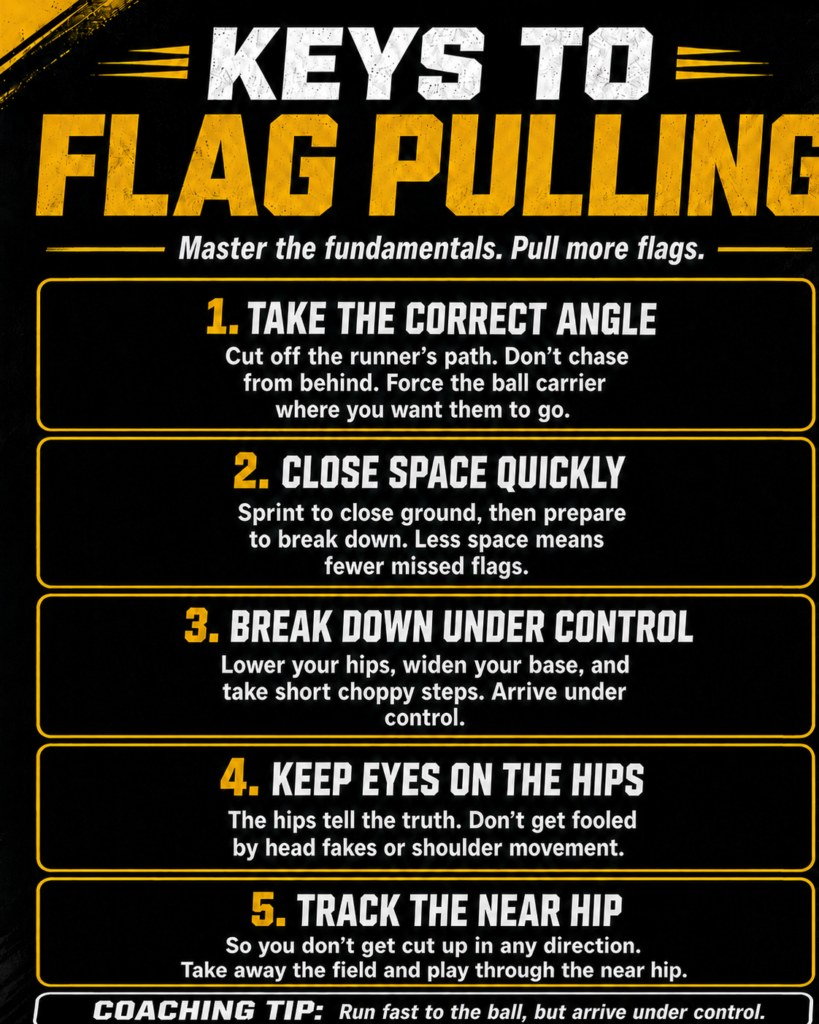
1. Take the Correct Angle
The first step to pulling more flags is taking a good pursuit angle.
Defenders should never chase directly behind the ball carrier unless they have no other choice. Instead, they should take an angle that cuts off where the runner is trying to go.
Bad angles lead to big plays.
Good angles force the ball carrier to slow down, cut back, or run into help.
Coaching Point:
Do not chase the flag. Cut off the runner’s path.
2. Close Space Quickly
Once the defender has the right angle, they must close the space between themselves and the ball carrier.
The more space the runner has, the more dangerous they become. Space allows the ball carrier to cut, spin, hesitate, and make defenders miss.
Defenders should run fast to close ground, but they must be ready to slow down before making the flag pull.
Coaching Point:
Sprint to close space, then get under control.
3. Break Down Under Control
One of the biggest mistakes defenders make is running full speed at the ball carrier and flying past the flag.
Before reaching for the flag, defenders should break down by lowering their hips, widening their base, and taking short, choppy steps.
This allows them to react if the ball carrier cuts.
Defenders should be athletic, balanced, and ready to move in any direction.
Coaching Point:
Arrive under control. Do not overrun the play.
4. Keep Your Eyes on the Hips
The ball carrier’s head, shoulders, and feet can all lie. The hips tell the truth.
Defenders should keep their eyes on the hip and belt area. This helps them track the flag and react to the runner’s movement.
When defenders look too high, they fall for shoulder fakes. When they look too low, they lose sight of the runner’s body movement.
Coaching Point:
Eyes on the hips. The hips will take you to the flag.
5. Stay Square to the Ball Carrier
Defenders should try to stay square as they approach the ball carrier. When defenders turn their body too early, they open up running lanes and make it easier for the runner to cut back.
Staying square helps defenders move laterally and keep leverage.
Coaching Point:
Stay square, stay balanced, and force the runner to make the first move.
How to Pull the Flag Properly
Use Two Hands Whenever Possible
The best flag pullers attack the flag with both hands.
Reaching with one hand can work, but it often leads to missed pulls. Two hands gives the defender a better chance to grab either flag and finish the play.
Coaching Point:
Two hands to the flag. Do not swipe with one hand unless you have to.
Pull Through the Flag
Defenders should not slap at the flag or swipe wildly. They should grab the flag and pull through it.
A clean flag pull requires control and finish.
Teach players to grab the flag firmly and pull it away from the belt.
Coaching Point:
Grab it, pull it, finish it.
Avoid Lunging
Lunging is one of the most common reasons players miss flags.
When defenders lunge, their feet stop moving, their body leans forward, and they lose balance. A good ball carrier will cut right past them.
Instead of lunging, defenders should keep their feet active and move with the runner.
Coaching Point:
Move your feet before you reach.
Common Flag Pulling Mistakes
Mistake 1: Running Past the Ball Carrier
Many defenders get too aggressive and run right by the runner.
Fix: Teach players to break down before they reach. Speed is important, but control is what finishes the play.
Mistake 2: Reaching Too Early
When defenders reach too early, they lose balance and give the ball carrier an easy cutback lane.
Fix: Close space first, then reach once the defender is in position.
Mistake 3: Looking at the Head or Shoulders
Ball carriers use head fakes and shoulder fakes to make defenders miss.
Fix: Keep eyes on the hips and belt area.
Mistake 4: Taking Bad Angles
Poor angles allow runners to get outside, turn the corner, and create explosive plays.
Fix: Take an angle that cuts off the runner’s path and forces them back inside to help.
Mistake 5: Not Rallying to the Ball
Flag football defense cannot rely on one defender making every play.
Fix: Teach every defender to pursue the football until the whistle. If the first defender misses, the next defender must be there.
Best Drills to Improve Flag Pulling
1. Flag Pull Alley Drill
Set up a narrow alley with cones. The ball carrier runs through the alley while the defender works to close space, break down, and pull the flag.
This drill teaches defenders to stay under control in tight space.
Focus: balance, short steps, two-hand flag pulls, and finishing.
2. Open Field Flag Pull Drill
Give the ball carrier more space and allow them to make one move. The defender must take a good angle, break down, and pull the flag in space.
This drill is great because it simulates game-like situations.
Focus: pursuit angles, leverage, patience, and open-field flag pulling.
3. Sideline Leverage Drill
Place the ball carrier near the sideline. The defender must use the sideline as an extra defender and force the runner toward the boundary.
This teaches defenders not to give up the outside.
Focus: leverage, angle, and using the sideline to help the defense.
4. Mirror Flag Pull Drill
The ball carrier moves side to side in a small box while the defender mirrors their movement. On command, the defender closes space and pulls the flag.
Focus: footwork, balance, eyes on hips, and controlled movement.
5. Team Pursuit Drill
The ball carrier starts with the ball and runs to one side of the field. All defenders must pursue with proper angles.
This drill builds defensive effort and teaches players to rally to the football.
Focus: pursuit, communication, effort, and team defense.
Coaching Tips for Better Flag Pulling
Flag pulling should be practiced every week. It does not need to take a lot of time, but it must be emphasized consistently.
Here are a few simple coaching tips:
- Start every defensive practice with flag pulling fundamentals.
- Use short, competitive drills to keep players engaged.
- Reward clean flag pulls in practice.
- Correct bad angles immediately.
- Teach players to run fast but finish under control.
- Make pursuit to the football a team expectation.
The more your players practice flag pulling, the more confident they will become on game day.
Final Thoughts on Flag Pulling
Flag pulling wins games.
Teams that pull flags well force longer drives, limit explosive plays, and make offenses earn every yard. Teams that miss flags give up easy touchdowns.
The best flag football defenses are not always the most complicated. They are the most disciplined.
Teach your players to take great angles, close space, break down, keep their eyes on the hips, use two hands, and rally to the football.
Master these flag pulling techniques, and your defense will immediately become faster, tougher, and harder to score against.