
The Mesh Rail Passing Concept is one of those passing concepts that gives a 7v7 flag football offense answers against multiple coverages without making things complicated for the quarterback. At its core, Mesh is designed to create traffic underneath with two crossing routes, while the Rail route adds a vertical element up the sideline- this is the ultimate man coverage beater.
That combination puts stress on the defense because they have to defend both the short underneath space and the deeper sideline at the same time. Below is a breakdown of the Mesh Rail Passing Concept.
𝐌𝐞𝐬𝐡 𝐑𝐚𝐢𝐥 𝐏𝐚𝐬𝐬𝐢𝐧𝐠 𝐂𝐨𝐧𝐜𝐞𝐩𝐭 𝐟𝐨𝐫 𝟕𝐯𝟕
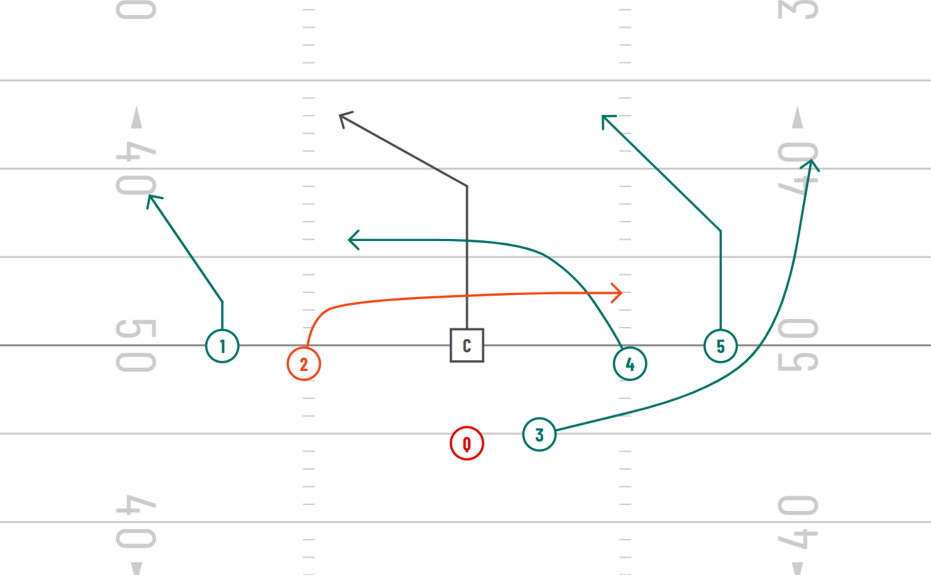
1: Fade route.
2: Under route- no more than 3 yards deep- flatten out.
3: Rail / wheel route.
C: Corner route- 8 yard stem.
4: Over route- no more than 6 yards deep- flatten out.
5: Post route- 6 yard stem- clear out.
QB Read: 2 to 4 to 3. You can change the progression based on matchups and / or defensive alignment.
If the coverage happens to be zone, the 2 and 4 should sit between the zone defenders.
What makes Mesh Rail so effective is that it allows your athletes to work in space. In flag football, you do not always need to throw the ball 25 yards downfield to create explosive plays. Sometimes the best answer is to get the ball to a receiver underneath, let them catch it on the move, and allow them to make a defender miss.
The crossing routes create natural separation, especially against man coverage, and the Rail route gives the quarterback a built-in shot if the defense loses leverage or gets caught chasing underneath.
Playbook: 7v7 Attack System Bundle
Quarterback Read on Mesh
The quarterback read should be simple. That is one of the biggest reasons this concept is so good for 7v7. The QB can start by identifying the coverage pre-snap. If it looks like man, he knows the crossing routes should create separation. If it looks like zone, he should be ready for the crossers to settle into open grass or for the Rail to open up along the sideline.
A simple progression could be: Rail, first crosser, second crosser, then checkdown. Some coaches may prefer to read the underneath defenders first and then work to the Rail based on matchup. Either way, the key is not to overcomplicate it. The concept works because it gives the quarterback answers quickly. The ball should come out on time.
Coaching Points for Receivers
Receivers running the Mesh routes need to understand spacing. If they run too shallow or too close together, the concept becomes messy. If they run too deep, the ball may come out late and the defense has time to recover. The goal is to cross with enough depth to create traffic, but still stay in a quick-game rhythm.
The Rail runner needs to get vertical with speed and maintain sideline spacing. They should not drift too wide too early or they may run themselves out of space. They also need to be ready for the ball quickly, especially if the defense busts coverage or the flat defender jumps the underneath route.
The biggest coaching point is that every route has a job. The crossers are not just running across the field. They are creating separation, forcing communication, and giving the quarterback easy throws. The Rail is not just a deep route. It is there to stretch the defense and punish defenders who overplay the Mesh.\
When to Call Mesh Rail
Mesh Rail is a great call on early downs when you want a high-percentage completion with big-play potential. It is also a strong third-down concept because the crossers can separate quickly and give the quarterback an easy answer. In the red zone, it can work well if you have enough space and your receivers understand how to settle against zone.
This concept is also a great answer when defenses are playing aggressive man coverage. If defenders are pressing, chasing, or locking onto receivers, Mesh Rail forces them to run through traffic and defend the entire width of the field. It is a simple way to make the defense work.
Final Thoughts
The Mesh Rail Passing Concept is a great 7v7 flag football concept because it is simple, flexible, and difficult for defenses to handle. It gives you underneath answers, creates natural separation against man coverage, and adds a vertical sideline threat with the Rail route. Best of all, it allows your quarterback to make quick decisions and get the ball to athletes in space.
If you are looking for a concept that works against multiple coverages and does not require a complicated install, Mesh Rail is a great addition to your passing game. Run it with good spacing, coach the receivers to understand man versus zone, and give your quarterback a clear read. When executed correctly, this concept can become one of your best answers in 7v7 flag football.