
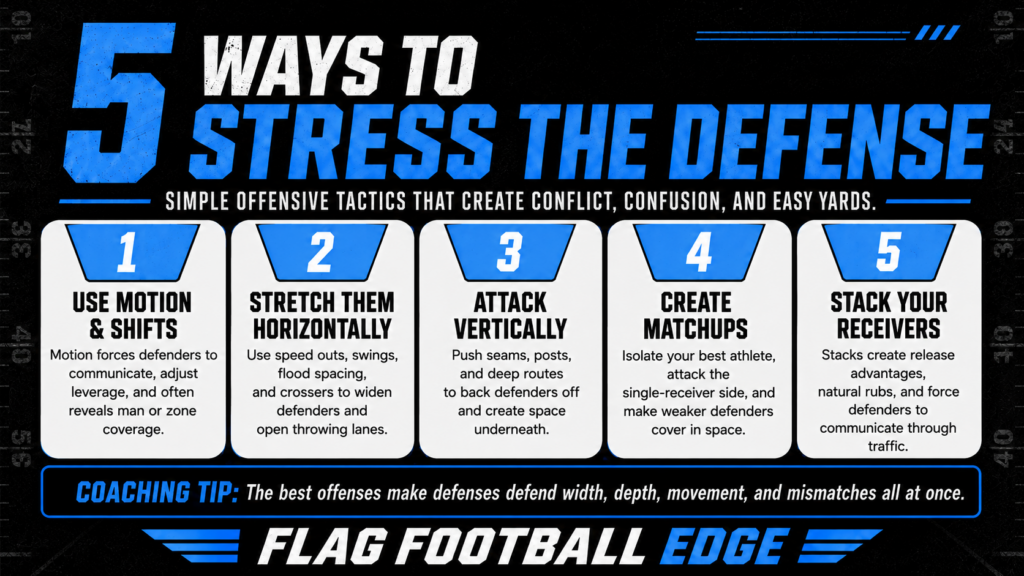
The best flag football offenses do more than just call plays — they create stress. They force the defense to communicate, adjust, cover space, and defend multiple threats at the same time. When you can make defenders think, move, and react before and after the snap, you create opportunities for easy completions, explosive plays, and coverage mistakes. Here are 5 ways to stress the defense in flag football.
5 Ways to Stress the Defense in Flag Football
1. Use Motion and Shifts
Motion and shifts are great tools because they force the defense to communicate and adjust before the ball is snapped. Even something as simple as short motion can create alignment conflict, change leverage, and reveal whether the defense is playing man or zone coverage. If a defender runs with the motion, it may indicate man. If the defense bumps or rotates, it may show zone.
Motion also helps create better matchups and cleaner releases for your receivers. You can use it to move a receiver away from pressure, stack a defender, widen the defense, or force a defender to cover in space. The more the defense has to adjust, the more likely they are to make a mistake.
2. Stretch Them Horizontally
One of the easiest ways to stress a flag football defense is to make them defend the entire width of the field. Speed outs, swing routes, quick flats, flood spacing, and shallow crossers force defenders to widen and cover space. When defenders widen, throwing lanes open up inside.
Horizontal stretch concepts are especially effective against zone coverage because they force underneath defenders to choose who they want to cover. If the flat defender jumps the short route, the QB can throw behind him. If the defender sinks or widens too slowly, the QB can take the easy completion in the flat. The goal is to make one defender responsible for two threats.
3. Attack Vertically
Defenses cannot sit on short routes all game if you are willing to attack vertically. Pushing seams, posts, wheels, fades, and deep routes forces safeties and deep defenders to back up. Once the defense starts respecting the deep ball, more space opens underneath for quick game, crossers, digs, and checkdowns.
Vertical routes do not always have to be thrown to be effective. Sometimes their biggest value is clearing space for another receiver. A deep route can pull a safety, occupy a corner, or open a window for an intermediate route. Good offenses use vertical threats to stretch the defense and create room for the rest of the concept.
4. Create Matchups
Flag football is a space game, and matchups matter. One of the best ways to stress a defense is to isolate your best athlete and force the defense to cover them in space. This could mean attacking the single-receiver side, putting your best receiver in the slot, or using formations that force weaker defenders into tough coverage situations.
Creating matchups is not just about speed. It is about leverage, alignment, and spacing. If you can get your best receiver matched up against a slower defender, or force a defender to cover too much grass, you give your offense a major advantage. Great play design puts your players in position to win.
5. Stack Your Receivers
Stacked receivers are a simple but effective way to create release advantages and natural traffic. When receivers are stacked, defenders have a harder time pressing, matching releases, and communicating through route combinations. This can create free releases, rubs, and easy separation.
Stacks are especially useful against man coverage because they force defenders to sort through traffic. They also help against zone because they can disguise route combinations and create spacing problems after the snap. A stack formation can make a simple concept much harder for the defense to handle.
Final Thoughts
The best offenses make defenses defend width, depth, movement, and mismatches all at once. When you use motion, stretch the field horizontally, attack vertically, create matchups, and stack your receivers, you force the defense to communicate and adjust on every snap. The more stress you create, the more mistakes you force- and the more easy yards your offense will generate.